How to be Early
May 22, 2026
You probably feel like you missed your chance.
Nvidia ran 10x. The friend who joined an AI lab in 2023 can retire. The roommate who bought ETH in 2016 lapped your 401k by a decade.
What you're feeling probably isn't envy but he slow suspicion that the chance for generational wealth already happened and you weren't anywhere near it.
Being early isn't a cognitive skill you can sharpen by consuming more content. The people who keep being early aren't smarter than you, simply closer to the problem.
They've arranged their lives so that certain kinds of information reach them before they reach the consensus. The change finds them because they're standing where it forms.
SECTION I - Why you're structurally late
There are three structural reasons most people are late to almost everything. Not necessarily character flaws but the default positions you ended up in.
1. Your information diet is downstream of consensus.
News, podcasts, newsletters, Twitter, research reports. None of them carry information until that information has already expressed itself as revenue, headlines, or a category somebody can write a piece about.
By the time NVIDIA hit the front page of the Wall Street Journal, the move was two years old. But even then, investing at that time would have yielded great returns. By the time a Substack writer had a clean thesis on AI agents, the people building them had burned through three product iterations. The Twitter feed you scroll for "edge" is mostly people repeating what the people they follow said three weeks ago. Who are themselves downstream of someone you'll never hear of.
Even the platforms that feel early (Substack, niche subreddits, X itself) are mostly faster ways to catch up. They look early because they move faster than legacy media. Really they are just a faster version of late.
2. You're an observer, not a participant.
Most jobs reward analyzing markets rather than using them. An analyst reads filings on a company he's never been a customer of. The PM reads research on a tool nobody on her team has opened. The consultant builds decks about a product his clients haven't shipped. The entire professional edifice runs on the assumption that you can understand a market from outside it well enough to make a good call.
You can do that for slow, well-understood markets. You can't for the ones forming right now, for ideas not yet discovered. What's about to be obvious isn't obvious yet because the people who would describe it from outside don't have anything to describe. The information lives with the people doing the work. And they aren't writing reports but shipping the product, living in that market.
By the time something is legible to an analyst, the people inside it have known for two years. That two-year lag is what I want to teach you to find. It's why the AI engineer who's been using these tools every day since 2021 doesn't need to read another piece about agents. He knows. The reason he knows isn't his Einstein level intelligence but he's been at his keyboard while you were reading about what he's been doing.
3. Your peer group is concentrated.
The people you talk to are mostly in your industry or similar views as you. The links sent in your group chats are about your world. The rooms you get invited into are filled with people doing the same kind of work you do. This feels normal but it's an important information problem.
The clarity you need rarely forms inside your peer group. By the time the people in your industry are excited about something, that something has already crossed the bar to be visible to your industry. The early ideas live elsewhere, in a consumer subculture you'd find weird or a specialist niche that doesn't read mainstream tech. Maybe a friend who works in a field you don't fully understand.
The reason finance people are late to consumer trends and tech people are late to capital flows isn't that they're stupid. It's that their information surface is one shape. Everyone they know reads the same Substacks, attends the same conferences, was at the same handful of schools. Anyone forming the kind of signal that would actually be early to them lives in a different shape entirely, and never shows up.
That's why large colleges are so powerful. Because they allow you to interact with thousands of different viewpoints, which help to shape your own and give you perspective into things you couldn't find elsewhere.
SECTION II - The reframe
So why do some people keep being early to everything (crypto, ai, memory, whatever's next) while everyone around them keeps being late?
The romantic explanation is that they're smarter. Or I guess more intuitive. Or they "just see things others don't." This is the story we like because it lets the rest of us off the hook. If being early is about being gifted, then being late is just bad luck of birth. Nothing we can do about it and that's quite bleak.
And it's wrong.
The thing you need to know about important information is that it isn't anywhere.
In 1945, Friedrich Hayek wrote a short paper called The Use of Knowledge in Society. He was arguing about central planning. The argument applies to any system where useful information lives. The knowledge that actually matters in an economy isn't concentrated anywhere. It exists, dispersed, in thousands of small, time-and-place-specific observations held by individual people. The factory manager knows his suppliers are getting unreliable, the shopkeeper knows demand for a specific item is up this month, the farmer knows the soil is changing in ways no satellite has caught. No central authority has any of this and nobody could assemble it even if they tried.
Trends work the same way. The knowledge of what's about to matter doesn't sit in a Bloomberg terminal, a finance influencer on X, or a Substack post. It lives, dispersed, in the heads of thousands of users, builders, early operators, and weirdos who are actually doing the thing. Some of them know things that would be worth billions if anyone aggregated them bt nobody is because you can't.
The implication is the entire point of this essay.
If the knowledge you want is dispersed, the only way to reach it is to spread yourself across where it lives. You can't centralize the information. You can decentralize yourself. The more places you have a foothold, the more chances dispersed signal has to reach you. A foothold can be a product you actually use, a group chat you're in, a friend whose work has nothing to do with yours.
This is sometimes called luck surface area. The more surface you expose to places where things are forming, the more luck you experience. People who get lucky in this way over and over aren't doing magic (I wish they were). They've just built more surface than the people around them.
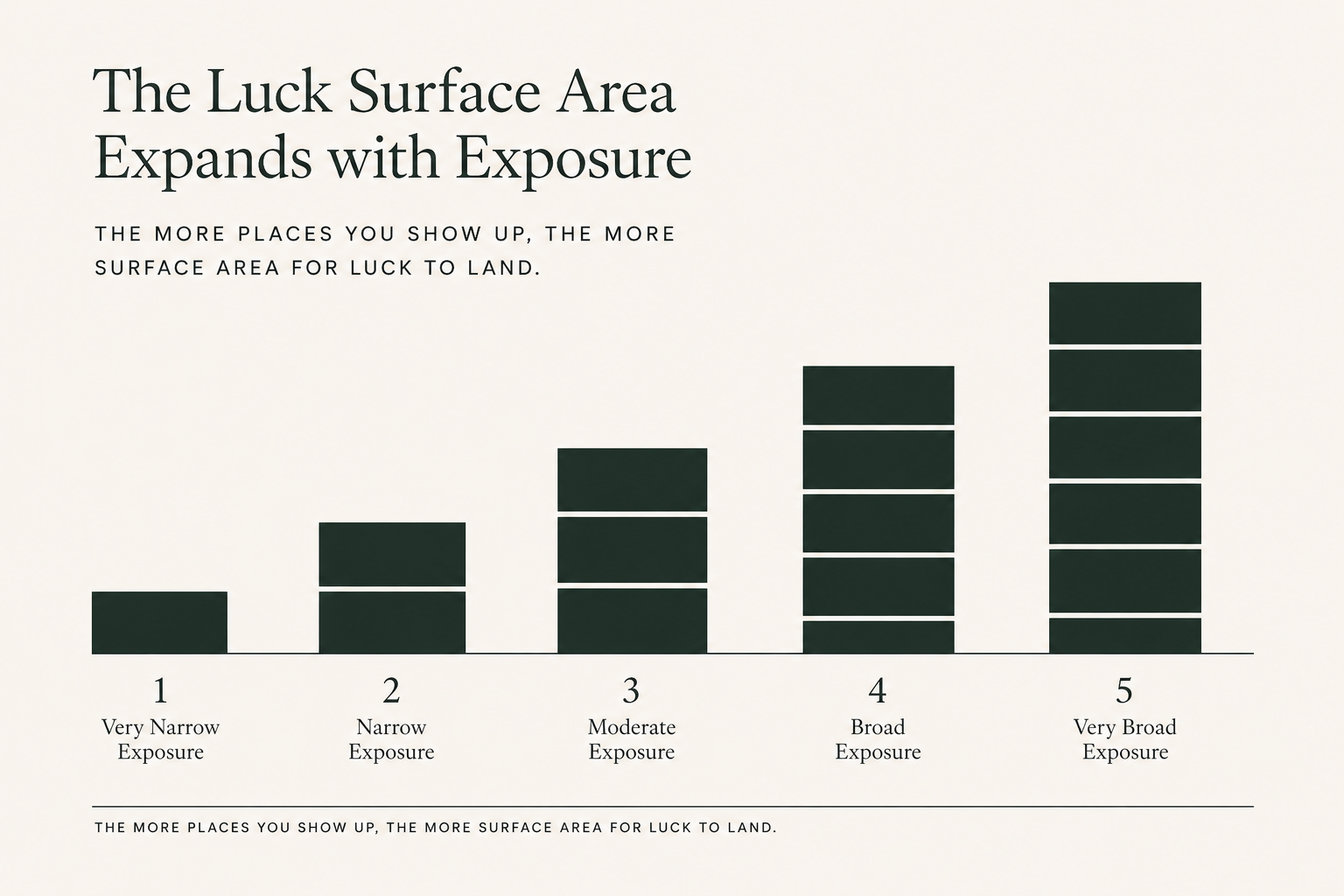
There's nothing mystical about it. One skill, one location, one industry, one peer group is a small surface. But seven skills, five mentors, twenty books, a few different communities make a much bigger surface. The chance of early adoption landing on you scales with that surface.
The trap most people fall into is trying to solve a surface-area problem with more of the same node. The leverage is lateral, not vertical. Differentiation is critical.
SECTION III - How to build your luck surface area
Five moves to build surface. They work because they fix the problem we just described, not because they require hidden talent you don't have.
1. Be a user before you are an observer.
Any field you want to be early to, start by using its product as a customer first. Use the new AI tools. Buy the small-cap stock. Trade the niche market. Open the weird app or subreddit. The cost of trying anything has never been lower in human history, and there is no excuse to be analyzing a thing you haven't touched.
Users see latent demand directly because they are the demand. The shape of a market is whatever its users do, and you can either watch the shape get reported (late) or be part of the shape getting made (early). There's no third position.
As an example, at Terminal X I spent a year watching our token spend climb steadily. The slope on the chart didn't match what the public market was paying for compute. Because I saw this happening every day, I figured it must be elsewhere and bet on more compute needed.
2. Build something. Anything counts.
Builders end up in conversations where shadow demand surfaces. That's the Hayek point in practice. You don't need to build something that succeeds because the thing you're trying to build is access to the rooms where other builders are.
Those people will tell you what they're seeing before anybody writes about it. They will tell you what's getting weirdly hard, what's getting weirdly easy, what their users are asking for that nobody is serving yet. None of this will be on any podcast for another six months. By the time it shows up on a podcast, three of the builders in the room will have already started companies to address it.
3. Diversify at the edges, not at the center.
Twitter is the center. Major newsletters are the center. The popular podcasts in any field are the center. The mainstream subreddits are the center. Anything with a large audience is the center. That's what "center" means. You are not going to be early to anything by consuming more of the center, no matter how much of it you consume.
The edges are specialist Discords nobody have heard of. Niche group chats where people who actually do the work talk to each other without performing. Conferences with under 200 attendees. Local meetups in cities that aren't yours. Friends in tangential fields one degree removed from yours, who tell you about what their world is doing.
Trading one center for another (Twitter for LinkedIn, NYT for Substack, CNBC for a popular tech newsletter) is not diversification. Diversification is going lateral into communities your peer group doesn't even know exists, and accepting that you'll feel weird and out of place in them for a while.
You will look stupid in those rooms at first. The people there know things you don't, and they don't owe you any explanation for why their world matters. Earn the right to be there by being curious without taking up space, and the information will flow toward you over time.
4. Talk across domains, not within them.
People in different domains use different vocabularies to describe the same underlying things. The new vocabulary always lags behind the new reality. By the time the vocabulary in domain A has caught up with what's already happening in domain B, the idea has already expressed itself. It's no longer early. The only way to access it fresh is to talk to people whose words for it haven't been translated into yours yet.
This is uncomfortable. You'll have to ask basic questions. People will sometimes assume you're stupid because you don't know the obvious term for the thing they're describing. That's fine because you don't need the term but the thing.
5. Notice where you're already a heavy user.
You almost certainly already have an asymmetric information advantage somewhere. A product you use obsessively or maybe some community you spend more time in than is professionally explainable. Most people don't recognize these as edges because they don't feel like edges. They feel like hobbies.
BUT THEY CAN BE EDGES. Those who keep being early professionally are the ones who learned to read their own life as data instead of dismissing it as personal.
This move is the most underrated of the five because nobody trains you to take your own behavior seriously as a source of information. Even school trains you to trust published material. Neither one tells you to trust the patterns of what you actually do. So start there.
SECTION IV - What you can't engineer
The trap with everything above is treating it like a project.
You don't build a luck surface area in a week. You don't build it in six months. You build it over years, by becoming the kind of person things keep happening to.
Luck surface area is a state, not an exercise. The five moves above describe what people already in that state do without thinking about it. You can imitate the behavior for a month. But if it stays a checklist, it doesn't compound. The compounding only starts when the moves stop feeling deliberate and start feeling like what your life is anyway.
The other thing the framework doesn't promise you is which signal will hit. You don't get to choose. You're building probability, not picking winners. Most will leave you with nothing.
Until one thing arrives. From the outside it will look like luck. But we'll both know its the obvious outcome of how you've been living for the past decade.
You can't pick which thing will be early. But you can be confident that nothing will be early if you're not anywhere near it.
So go be early.
-- Gabriel